The Strategic Context: From Efficiency to Resilience
For decades, Europe’s global supply chains were built primarily around efficiency and cost. That logic is now changing. The twin shocks of the COVID-19 pandemic and the Russia–Ukraine war exposed a dangerous vulnerability: over-concentration of production and energy dependence on limited geographies.
Europe is shifting from “single-source efficiency” to “multi-source resilience,” and India is becoming one of the anchors of that model.
The India–EU Free Trade Agreement (FTA) fits directly into this strategic recalibration.
The Economic Foundation: A Partnership Already in Motion
Current Trade Volume (2024–25)
Bilateral trade is already substantial and growing:
Merchandise Trade: USD 136.54 billion
- Indian exports to EU: USD 75.85 billion
- Indian imports from EU: USD 60.68 billion
Services Trade: USD 83.10 billion (2024)
This makes the EU:
- India’s largest goods trading partner
- A major destination for Indian exports (about 17% of India’s total exports)
- India represents around 9% of total EU overseas shipments
Growth Momentum
India–EU merchandise trade has grown strongly over the past five years, with total bilateral goods trade increasing from ~$90 bn in 2020-21 to ~$136 bn in 2024-25, demonstrating strong upward momentum even before the FTA.
The Scale of Opportunity
This agreement connects:
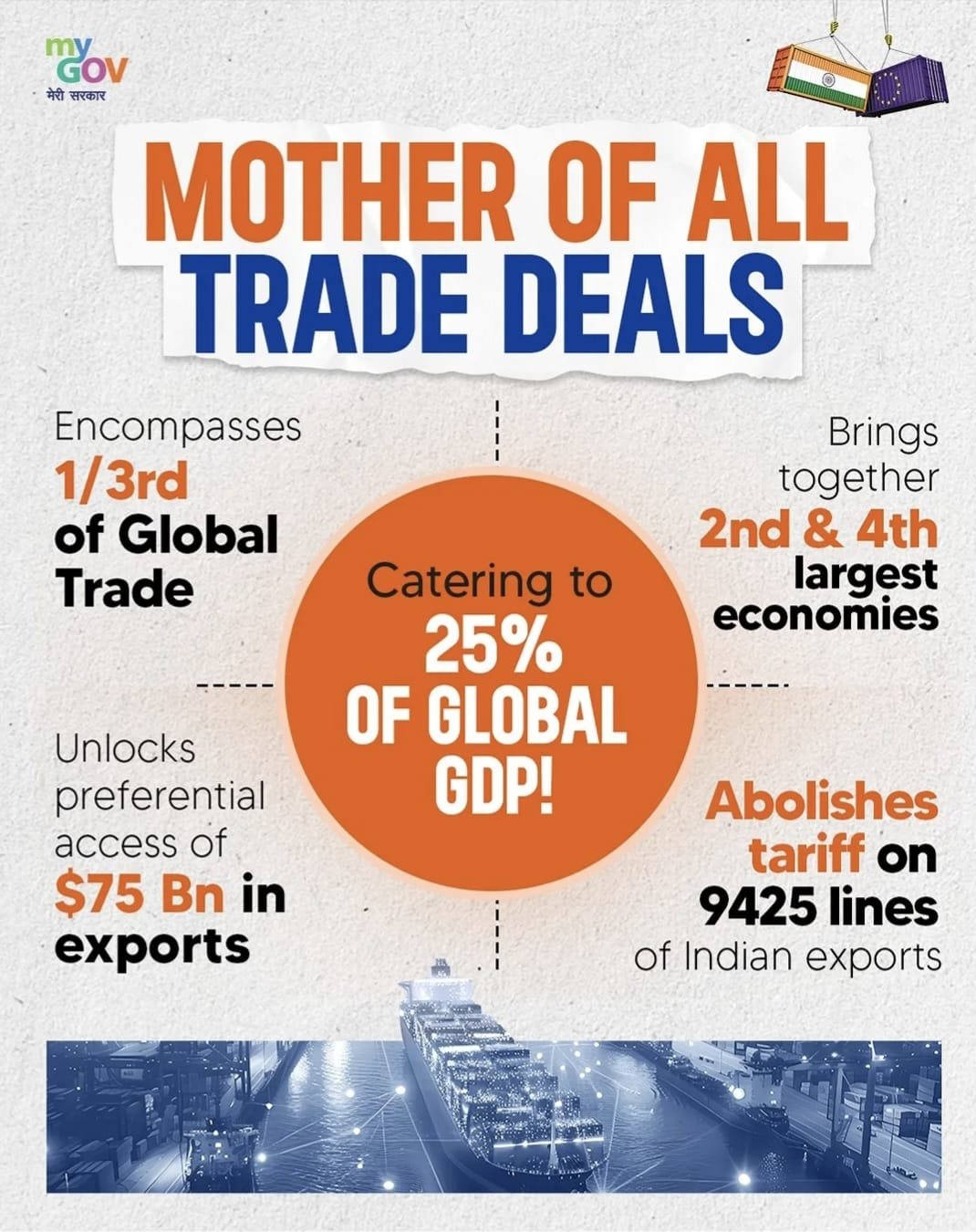
- 27 EU economies (~$19.5 trillion GDP) with India (~$3.7 trillion GDP)
- Population: Over 450 million in the EU – a wealthy consumer base with high purchasing power
- Combined coverage: Nearly one-third of global trade flows
European Investment in India
Europe is a major capital partner for India:
- EU FDI stock in India: €140.1 billion (2023), making the EU one of India’s largest sources of foreign capital
- Operating presence: Around 6,000 European companies operate in India, generating jobs and boosting local supply chains
This existing investment base strengthens the foundation for deeper industrial cooperation post-FTA.
Why Europe Is Rebalancing Supply Chains
Recent global disruptions, from pandemic supply shocks to geopolitical tensions, have made Europe rethink its production and sourcing strategies.
Though precise EU data on sector exposures varies, EU policymakers have repeatedly stated that trade diversification is a priority. The India–EU FTA supports that aim by reducing barriers and aligning regulatory frameworks.
For India, this shift translates into:
- More predictable market access
- Stronger integration into European supply networks
- Improved leverage in global trade negotiations
The Deal Structure: Comprehensive Tariff Liberalization
The EU has agreed to eliminate or reduce duties on around 97% of tariff lines, covering over 99.5% of the trade value between India and the bloc.
This means exporters, especially in labour-intensive and manufactured goods, gain significant cost advantages compared to pre-FTA levels.
Although final details will depend on ratification and implementation phases, this coverage level is among the most ambitious trade liberalisation efforts undertaken by India or the EU in recent history.
Sectoral Impact: Where the Real Upside Lies
While the exact post-FTA tariff schedule will be implemented over time, several sectors stand to benefit significantly:
Textiles
- Zero-tariff access to a $263 billion EU market
- Strengthens India’s export competitiveness against countries like Vietnam and Bangladesh
Gems & Jewellery
- Preferential access to 100% of the EU trade basket
- Supports India’s position as a global processing and value-add hub
Chemicals
- Duty-free access for 97.5% of India’s chemical exports by value
- Strengthens MSME-led clusters and promotes high-value, and technologically advanced products, positioning India as a trusted supplier to EU’s nearly $500 billion chemical market for imports
Engineering Goods
- Preferential access for engineering goods presently facing tariffs as high as 22%
- Will empower MSME-led industrial hubs, catalysing industrial modernisation, global competitiveness, and improve share in EU’s nearly $2 trillion engineering goods imports
These are not marginal industries. They represent the core of India’s manufacturing and export strategy.
Access to the World’s Wealthiest Consumer Market
The EU remains:
- One of the highest per-capita income regions
- A stable demand base
- A premium pricing market
Indian companies gain easier entry into:
- High-value consumption
- High-margin exports
- Long-cycle contracts
This shifts India from being only a low-cost producer to a reliable supplier for developed markets.
India’s Evolving Trade Architecture
With the EU now becoming India’s 22nd FTA partner, the country is moving towards broad-based trade integration.
This transition matters because:
- Trade agreements create policy continuity
- Policy continuity attracts long-term capital
- Long-term capital supports industrial scale
Beyond Trade: Strategic & Security Dimensions
Unlike conventional FTAs, the India–EU agreement extends into non-trade domains.
Alongside the Free Trade Agreement, India and the EU signed a Security and Defence Partnership that strengthens cooperation in maritime security, defence industry collaboration, cyber and hybrid threat response, space and counter-terrorism cooperation, and launched negotiations on a Security of Information Agreement to facilitate exchanges of classified information.
This matters because capital-intensive sectors such as defence manufacturing, aerospace, and advanced electronics require long-term strategic trust and alignment, not just tariff relief.
Security cooperation reduces:
- Geopolitical risk premium
- Regulatory uncertainty
- Long-term contract risk
Mobility & Talent Pathways
The agreement also:
- Creates legal pathways for skilled Indian professionals
- Encourages student and researcher mobility
- Enables joint academic and research partnerships
This supports:
- Knowledge transfer
- Industrial R&D
- Advanced manufacturing
- Digital and engineering services
From a productivity standpoint, talent mobility directly affects innovation cycles, operating margins, and long-term competitiveness.
Strategic Takeaway: Rebalancing Trade and Capital Flows
This agreement comes at a time when global trade is being reshaped by:
✔ Diversification of supply chains
✔ Rising geopolitical uncertainty
✔ The need for predictable and rules-based economic engagement
By integrating more deeply with the EU – one of the world’s most stable economic blocs, India gains not just market access but strategic economic alignment.
This means:
- Broader opportunities across export-oriented sectors
- Improved visibility and long-term planning potential
- A stronger position in global economic networks
From Europe’s standpoint, reducing trade friction with India builds resilience and offers alternative pathways amid global trade tensions.